
Save the Bees: What Actually Happens During a Honey Bee Relocation in Phoenix
You found a colony in a block wall, water meter box, soffit, roofline, tree, or other protected space and want to know whether it can be moved instead of killed. This guide explains what happens from the first inspection through extraction, cleanup, relocation, and sealing the original cavity.
Why Honey Bees Matter in the Sonoran Desert
Honey bees are working pollinators, and in Arizona they support citrus, melons, squash, alfalfa seed, backyard gardens, and other crops. A colony that is a hazard on the side of a house can still be useful once moved to a managed location.
The United States Department of Agriculture tracks pollinator contribution to the national food supply. For homeowners, the practical point is simple: the choice is usually not between keeping the colony in your wall and killing it. It is between removing it responsibly and leaving the structure with the consequences of extermination.
Why Spraying a Structural Colony Can Create a Second Problem
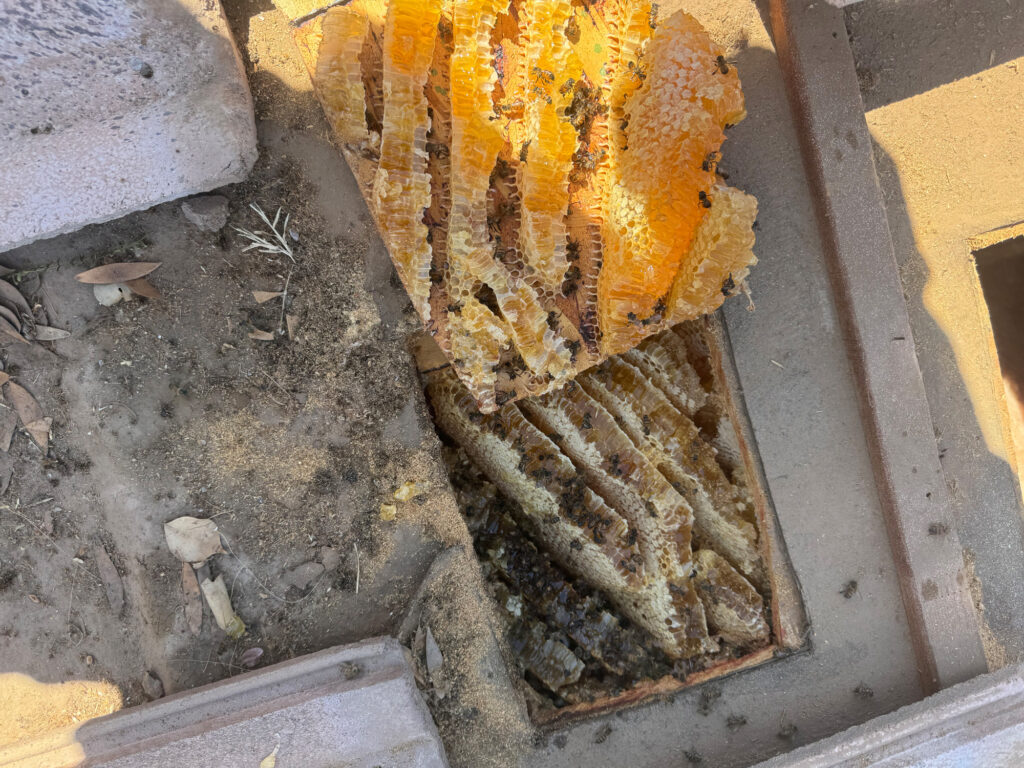
Inside a structure, extermination often leaves behind the exact materials that create the long-term problem. Comb remains in the cavity, honey can soften and run in Phoenix heat, and residue can attract ants, roaches, rodents, and future scout bees.
| Outcome | Relocation | Extermination |
|---|---|---|
| The colony | Collected alive and rehomed with beekeepers | Killed in place |
| Comb and honey | Removed from the cavity | Usually left inside the structure |
| Structure | Opened, cleaned, and closed properly | Risk of staining, odor, and secondary pests |
| Repeat occupancy | Entry point sealed against future swarms | Cavity may still read as a proven nest site |
| Pollinators | Colony continues working elsewhere | Colony lost |
Relocation solves the problem at the cavity, not only at the insects. The colony leaves, the honeycomb comes out, the space is cleaned, and the opening is corrected so the next swarm does not find the same vacancy.
How Honey Bee Removal Differs From General Pest Control
How a Colony Gets Established Inside a Structure
Many structural colonies begin as a swarm looking for a protected cavity. Scout bees inspect block walls, soffits, chimney chases, water meter boxes, irrigation valve boxes, roof spaces, and similar voids for a defensible entrance, shade, and enough interior volume.
Field note: The entrance you can see is often not where the comb is. Bees may enter at one opening and travel along the cavity before building, which is why mapping the colony comes before cutting into the structure.
The Honey Bee Relocation Process
Every property is different, but the structural sequence follows the same logic. This is the scope behind The Buzzing Bee's live bee removal service.
Assessment
The technician tracks flight paths, listens along the wall, and uses available evidence to map where the colony actually sits.
Site Safety
Children and pets stay inside, nearby work areas are cleared, and surrounding occupants are warned when needed.
Protective Setup
The crew uses suits, veils, gloves, and smoke to reduce defensive response before the cavity is opened.
Structural Access
Block, stucco, soffit panels, or other finish material are opened deliberately with repair in mind and with attention to wiring, plumbing, and framing inside the same void.
Collecting the Colony
A purpose-built low-suction bee vacuum moves the insects into a ventilated holding box without the destructive suction of a shop vacuum.
Finding the Queen
The crew works comb face by face to find and secure her because the colony reorganizes around her scent.
Saving Brood Comb
Comb holding eggs and larvae is cut out and secured into frames so the colony can continue raising the next generation after the move.
Cleaning the Cavity
Accessible wax, honeycomb, honey, and residue are removed to reduce staining, odor, secondary pests, and repeat occupancy.
Sealing and Closing
The entry point and nearby gaps are corrected after the cavity is empty, then opened materials are rebuilt and finished.
Transport
The colony travels in a closed ventilated box to its new location, with timing adjusted for Arizona heat.
The queen decides the outcome. A colony collected without her may not settle successfully, which is why a crew can appear to spend a long time on one section of comb.
Where the Colony Goes and What Beekeepers Do With It
After collection, the colony is moved into a standard hive body and given time to settle. Saved brood comb goes into frames, the queen is released, and the colony reorganizes around her.
Relocated colonies may be placed with local beekeepers in areas such as Queen Creek and the East Valley where they have forage, water, and ongoing management.
Why the Entry Point Gets Sealed Last
Sealing matters, but the order matters more. Closing an opening before the colony and comb are removed can trap insects inside the structure, where they may push through drywall, vents, light fixtures, or other interior gaps.
Once the cavity is empty and cleaned, correcting the opening helps prevent scouts from reusing the same weep holes, vents, fascia gaps, or eave openings during the next swarm season.
When Relocation Is Practical and When It Is Not
Can the Colony Be Reached?
A cavity behind repairable finish material may be practical to access. A colony deep in a chimney flue or inaccessible structural void can be more difficult.
Can the Queen Be Located?
Successful relocation depends heavily on securing her and keeping the colony organized after the move.
What Condition Is the Colony In?
Earlier pesticide exposure, disease, heat stress, or other damage can affect whether the colony is suitable for relocation.
What Are the Heat Conditions?
Transport and work timing change during extreme summer temperatures because collected insects cannot sit in a closed box in direct sun.
Can the Area Be Controlled Safely?
Shared walls, schools, pool decks, walkways, and other occupied areas can change the sequence and timing of the work.
What to Do and What Not to Do
Field note: Sealing the entry hole while the colony is still active is one of the most common homeowner mistakes. Trapped insects may simply search for another opening into the structure.
Why the Difference Changes the Job
| Condition | Swarm | Established Colony |
|---|---|---|
| Comb and brood | Usually none | Present inside the cavity |
| Typical location | Branch, fence, patio beam, temporary exterior cluster | Wall, roof, soffit, chimney, irrigation box, or other enclosed space |
| Structural access | Usually not required | Often required |
| Cleanup | Minimal | Comb, honey, wax, and residue may need removal |
| Urgency | Calling early may prevent structural nesting | Full extraction and cavity closure are usually the correct scope |
Swarm removal: A swarm is a cluster in transit with no established comb, brood, or stores. It is often calmer and easier to collect. Structural colony removal: Once the insects live inside a wall or roof cavity with honey and brood, the work becomes an extraction rather than a simple collection.
Seasonal Timing Across the Valley
How to Find Bee Relocation Services Near You
Homeowners may search for bee relocation near me, bee relocation services near me, local beekeeper removal, bee hive removal service, bee rescuers, bee relocators near me, or similar terms. The wording in an ad matters less than the actual scope.
Questions to Ask Before You Hire
- Do you collect the colony alive, and where does it go afterward?
- Do you remove the comb and honey or only the insects?
- Is repairing and sealing the opening included in the scope?
- What equipment do you use for collection?
- Are you licensed and insured for the structural work involved?
- How do you handle a colony that is larger than expected once the wall is open?
- Will you put the scope in writing and provide a quote before work starts?
A Note on Africanized Bees in the Phoenix Metro
Wild colonies across central and southern Arizona can carry Africanized ancestry, which affects how defensively some colonies respond when disturbed. The University of Arizona Cooperative Extension publishes guidance on Africanized honey bees in the state, and the Arizona Department of Agriculture oversees apiary matters statewide.
The practical takeaway is straightforward: treat every wild colony cautiously, keep distance, and let people in protective gear open the structure. Relocation can still be possible, but the site has to be controlled correctly.
Frequently Asked Questions
Can Africanized bees be relocated alive?
Often yes. Defensive behavior changes how the site is controlled and how the work is performed, but it does not automatically make relocation impossible.
Will the same colony come back after relocation?
The relocated colony leaves with its queen. A new swarm can use the same cavity later if residue remains and the original entrance stays open, which is why cleanup and sealing matter.
Do you remove the honeycomb or only the insects?
For structural extraction, accessible comb is removed because leftover honey and wax can create staining, odor, secondary pests, and repeat occupancy problems.
How long does a honey bee relocation take?
An exposed swarm can be collected quickly. A colony inside a block wall, roof, or soffit takes longer because the structure must be opened, comb removed, the cavity cleaned, and the opening closed.
Is the process safe with children and pets at home?
Yes, with normal precautions. Keep everyone indoors during active work, close nearby windows and doors, and stay away from the flight path until the crew clears the area.
Can I call a local beekeeper instead?
Sometimes. A local beekeeper may be appropriate for an easy swarm on a low branch. Structural colonies require a crew able to open, clean, seal, and repair the cavity as well as relocate the colony.
What if the colony is inside a block wall or roof?
That is structural extraction. The wall or roof section is opened deliberately, the colony and comb are removed, and the opening is rebuilt and sealed. If you are still trying to identify the problem, read our warning signs article.
Honey Bee Relocation in Phoenix and the Valley
The Buzzing Bee is a family owned removal company based in Phoenix. Honey bee colonies are collected alive wherever practical, accessible honeycomb and honey are removed, and the cavity is cleaned and sealed so the next swarm keeps moving. Wasps, hornets, and yellowjackets are handled as nest removal.
Need Honey Bee Relocation in Phoenix?
If you have an exposed swarm, an established colony inside a wall or roof, or activity near children, pets, doors, patios, or pools, do not spray or seal the opening before the colony has been evaluated.