Bees in the Pool? How to Safely Manage and Relocate Thirsty Honey Bees in Phoenix
If a cloud of bees has descended on your backyard pool this week, take a breath. You are not alone, your family is not in immediate danger if you stay calm, and there is a humane way to solve this that does not involve killing the colony.
Bees collecting water are often traveling from an established colony nearby. A professional inspection focuses on locating and resolving the colony rather than simply treating bees at the pool.
Why Bees Are Suddenly All Over Your Phoenix Pool
Every July, our phones start ringing before 7 a.m. It is the same story from Ahwatukee to North Scottsdale to Queen Creek: a homeowner walks outside with coffee and finds dozens, sometimes hundreds, of honey bees hovering over the pool, crawling along the tile line, and drinking from the skimmer. By afternoon, the family cannot use the backyard.
When Phoenix hits 110°F and higher, a honey bee colony has one urgent job: cool the hive. Worker bees fly out searching for water, carry it back in their crops, and fan it across the comb so evaporation drops the internal temperature. A colony of 40,000 bees can haul several liters of water on a single hot day, and the closest reliable source in the Valley of the Sun is almost always a swimming pool.
Once a scout bee finds your pool, she flies home and dances the location to the rest of the colony. Within a day or two, the whole hive is committed. That is why the problem escalates so quickly and why simply waiting it out rarely works.
The pool activity is usually a symptom. The underlying issue may be an active colony in a block wall, roof soffit, utility box or another protected location within flight range of your home.
Why Your Pool Specifically?
You might wonder why bees choose your chlorinated or salt pool over the neighbor’s fountain or a natural wash. Research and years of field experience point to the same answer: bees actually prefer water with a mineral or chemical scent.
Detectable Water Scent
Chlorine and salt give off subtle odors that bees can detect from a distance.
Warm Pool Water
Warm water evaporates faster, releasing more scent into the surrounding air.
Safe Landing Areas
Travertine, flagstone and pebble tec provide places for bees to land without immediately drowning.
Predictable Moisture
Auto-fill lines, skimmers and damp edges create a consistent water source bees can revisit.
If your yard checks those boxes, you have essentially built a five-star bee watering hole. That is not your fault. It is a byproduct of living in the desert with a pool during a heat wave.
Other Water Sources Bees Target in the Valley
Pools get the headlines, but bees will hit any consistent water source on your property. If you are seeing bee activity, check these too:
- Evaporative, or swamp, coolers on rooftops
- Drip irrigation emitters and leaking hose bibs
- Decorative fountains, bird baths and pondless waterfalls
- Pet water bowls left outside
- Condensation drip lines from AC units
- Damp pool decks and puddles under misters
Sometimes eliminating a secondary source is enough to reduce the pressure on your pool while you arrange professional help. Sometimes it is not, because the real issue is a nearby colony that needs to be relocated.
Learn more about available bee removal services or check whether your community is included in The Buzzing Bee’s Phoenix-area service areas.
Safety First: The Africanized Bee Reality in Arizona
Here is a fact every Phoenix homeowner should know: more than 90 percent of wild honey bee colonies in the Phoenix metro are Africanized. They look identical to European honey bees, but they defend their hive far more aggressively and in much greater numbers.
A colony that seems calm at the pool can turn defensive the moment you get close to its actual nest, which may be in a block wall, water meter box or wall cavity nearby.
Please Do Not Do Any of the Following
- Spray the bees at the pool with pesticide, wasp spray or a hose. This kills only a fraction and can provoke the colony.
- Pour gasoline, bleach or soap into a suspected nest opening. This is dangerous, illegal in some cases and rarely effective.
- Plug a wall opening while bees are actively flying in and out. Trapped bees may chew through drywall into your home.
- Let children or pets near the pool until the situation is professionally assessed.
- Attempt DIY removal without a full bee suit, smoker and vacuum system.
If bees become aggressive: get inside immediately, close doors and windows, and call for professional help. Bees can pursue a target for a quarter mile or more.
Short-Term Steps You Can Try Today
These will not solve the underlying problem, but they can reduce activity while you wait for a licensed relocator to arrive.
Offer an Alternative Water Source Away From the Pool
Set up a shallow container of water with rocks or corks for bees to land on, placed 30 to 50 feet from the pool. Add a splash of pool water so the scent matches. This may pull some pressure away from the pool edge.
Cover the Pool During Peak Bee Hours
Bees are most active from mid-morning to late afternoon. A solar cover or safety cover during those hours reduces the surface area they can access.
Time Family Swims for Early Morning or Dusk
Bees generally return to the hive before sunset. Early morning swims before the colony has fully woken up are safer for kids.
Avoid Florals, Perfumes and Sweet Drinks Poolside
Floral perfumes, strongly scented sunscreens, sugary drinks and open trash cans can attract more bees. Keep the pool deck simple during a swarm event.
Do Not Swat
A crushed bee releases alarm pheromones that can call more bees to the area. Move slowly, walk away and give them space.
Why Deterrents Alone Never Fix the Problem
Here is the hard truth: as long as there is an active colony within flight range of your home, roughly one to three miles, bees will keep coming back to your pool. Sprays, ultrasonic devices, mothballs, dryer sheets and citronella candles do not relocate the colony. They just temporarily annoy foragers.
The only permanent, humane fix is finding the hive and relocating it.
That is the work The Buzzing Bee performs across Phoenix, Mesa, Scottsdale, Gilbert, Queen Creek, Peoria and Fountain Hills. Depending on the hive location, the solution may include live bee removal, complete honeycomb removal and repair, and preventive sealing to reduce the risk of another colony entering the same cavity.
What Live Bee Relocation Actually Looks Like
When you call The Buzzing Bee, here is what happens next.

Locate the Colony
A technician arrives in full protective gear and inspects the property. Foragers at the pool are a symptom. The nest may be hidden in a block wall, water meter box, roof soffit, chimney, saguaro cavity or irrigation valve box. Visual tracking and, when needed, thermal imaging are used to pinpoint the hive.
Assess the Situation
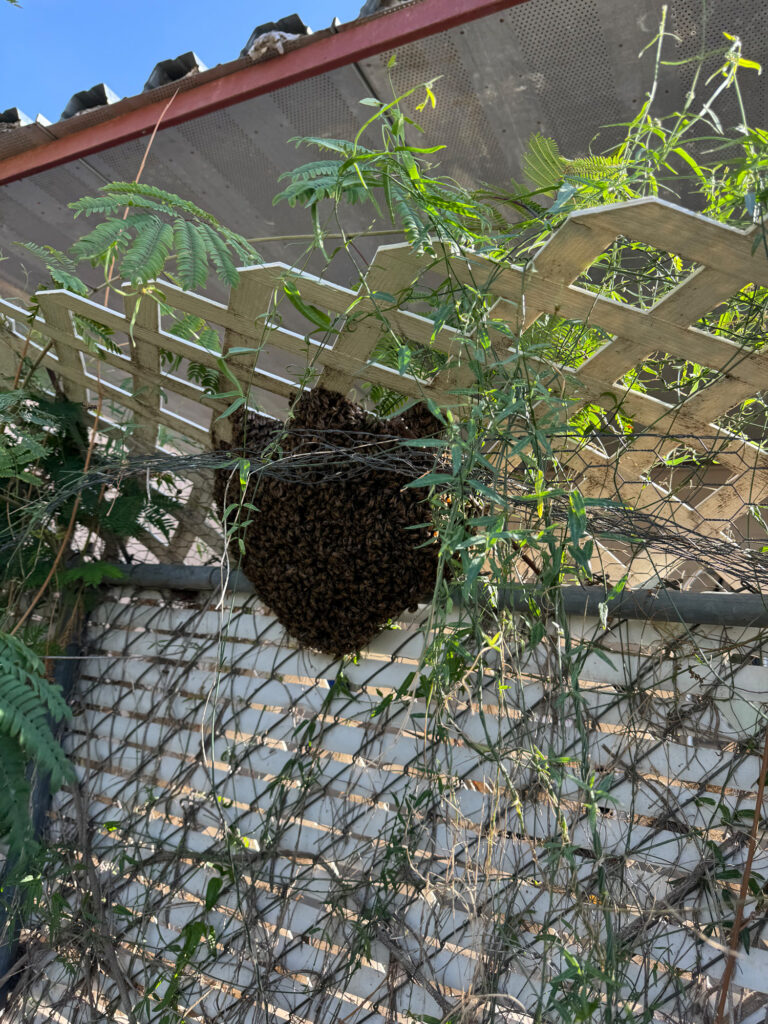
The technician identifies whether the colony is a temporary swarm cluster or an established hive containing built comb, brood and honey stores. These situations require different approaches.
Vacuum the Bees Alive
Specialized low-suction bee vacuums with ventilated collection boxes are used to gently capture workers without harming them. The goal is to keep the colony intact, including the queen.
Secure the Queen
A colony without its queen will not survive. The queen is located and safely transferred to the transport box so the rest of the colony bonds to the new location.
Remove Comb, Honey and Wax
When the hive is established, every trace of comb and honey is removed. Phoenix summer heat can melt abandoned wax and honey, stain walls, attract rodents and ants, and invite a new colony to move in.
Relocate to Local Apiaries and Farms
Captured colonies are transported to partner apiaries and organic farms in the East Valley and Queen Creek area, where they pollinate crops and produce local Arizona honey. No pesticides, no killing.
Seal and Bee-Proof
If the hive was inside a structural cavity, the entry point is sealed so a new colony does not move in next season. For block walls, that often includes proper masonry repair and weep-hole screening.
Proactive bee prevention services may also help identify and close vulnerable openings before another swarm establishes a hive.
When to Call Immediately
Some situations should not wait until Monday morning. Call right away if any of the following are true:
- Bees are defensive, chasing or stinging when anyone walks outside.
- A visible cluster is growing day over day on a wall, tree or eave.
- Bees are flying in and out of a wall opening, roof vent or block-wall weep hole.
- Anyone in the household has a bee sting allergy.
- Small children, elderly family members or pets share the yard.
- You manage a commercial property, HOA common area or short-term rental.
Frequently Asked Questions
Are the honey bees drinking from my Phoenix pool dangerous?
Foraging bees at the water’s edge are generally focused on collecting water and are not looking to sting. The danger is not the pool bees themselves, it is the colony they came from. If that colony is Africanized and lives within flight range, anyone who walks near the actual nest can trigger a defensive response. That is why locating and relocating the hive matters.
Do you serve Mesa, Scottsdale and Gilbert or just Phoenix?
The Buzzing Bee serves the entire Valley, including Phoenix, Scottsdale, Mesa, Gilbert, Queen Creek, Peoria, Fountain Hills and surrounding communities. Whether you need bee removal in Phoenix or bee removal in Mesa, one call reaches the same team. View the complete service area for more information.
Will you kill the bees or actually relocate them?
The Buzzing Bee is a live bee relocation company. Its standard process is to vacuum the colony alive, secure the queen and transport the bees to partner apiaries and East Valley farms. Extermination is a last resort the company generally does not perform, because Arizona agriculture and desert ecology need the pollinators that can be saved.
How long before the bees are gone after you arrive?
A swarm cluster on a branch can often be captured in under an hour. An established hive inside a block wall or structure takes longer, sometimes several hours, because all comb and honey must be removed and the cavity properly sealed. Foragers still in the field may return over the next day or two looking for the queen and will disperse once they realize she is gone.
Can I just wait for the bees to leave on their own?
A true swarm, meaning a resting cluster with no comb yet, may move on in one to three days. But if bees are actively coming to your pool from an established hive nearby, they will not leave until the colony is relocated or the water source is removed. Waiting usually means the problem grows.
Visit the complete bee removal FAQ page for more answers about swarms, structural hives and the relocation process.

Ready to Reclaim Your Backyard?
You should not have to give up your pool during the hottest month of the year, and you do not have to harm the bees to get your yard back. The Buzzing Bee is Phoenix’s family-owned, humane bee relocation specialist, and summer is what the team trains for all year.