
Wasp Nest Removal in Scottsdale and the East Valley: How to Identify and Safely Remove Dangerous Nests
An umbrella shaped nest tucked under a stucco eave is one of the most common nests Valley homeowners find. This guide explains how to identify the insect, when a nest is a real hazard, why certain removals go wrong, and what professional wasp nest removal actually involves.
Wasp, Hornet, Yellow Jacket or Honey Bee?
Identification decides everything that happens next. A honey bee colony inside a wall is a live removal and relocation job. An umbrella nest under an eave is a treatment and removal job. Treating honey bees like wasps can leave melting comb inside an Arizona wall.
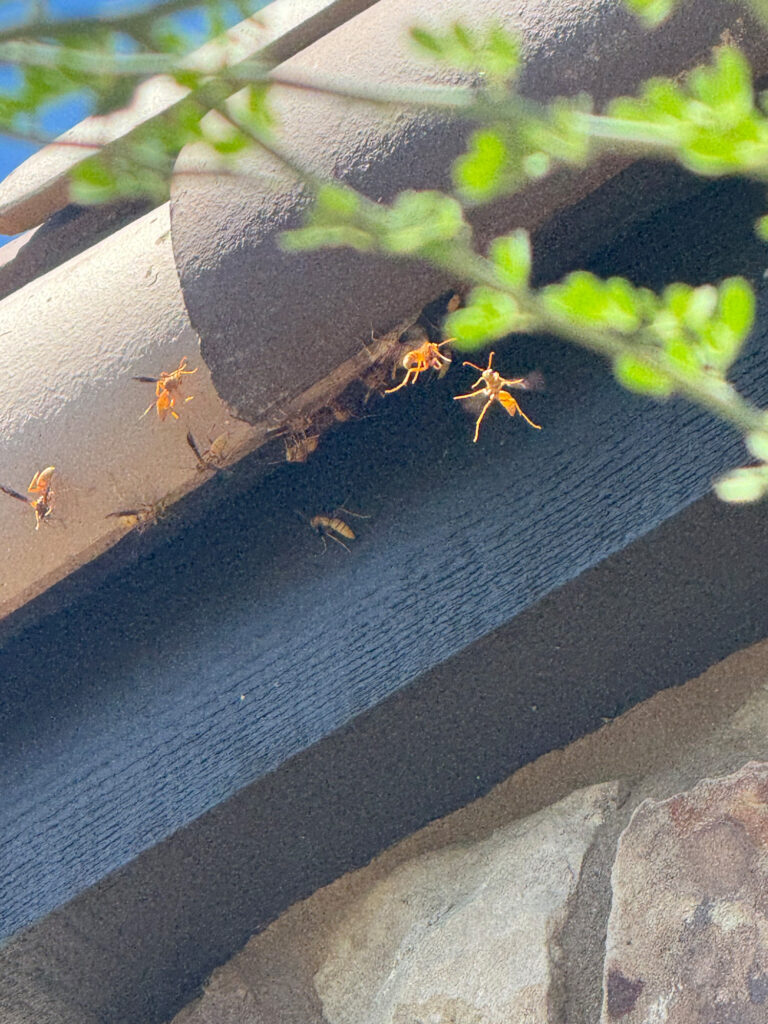
Look at three things: the body, the nest, and the behavior. Honey bees are fuzzy, golden brown, and thick through the middle. Umbrella wasps are slender with long trailing legs. Yellow jackets are shorter, stockier, smooth, and bright yellow and black. Mud daubers are long and thin and are usually not aggressive.
The Nest Tells You More Than the Insect
| Feature | Umbrella Wasp | Yellow Jacket | Honey Bee |
|---|---|---|---|
| Nest | Open gray comb on a stalk | Enclosed ball, wall void, or ground | Wax comb in a cavity |
| Body | Slender, long legs dangling | Stocky, smooth, bright bands | Fuzzy, golden brown |
| Aggression | Defensive near the nest | Aggressive, especially in fall | Defensive mainly at the entrance |
| Food Interest | Insects and some nectar | Meat, sugar, trash, drinks | Nectar and pollen |
| Correct Response | Wasp treatment and nest removal | Yellow jacket removal and cleanup | Remove alive and relocate |
If what you are looking at is a honey bee colony, stop and read about live honey bee removal instead. Honey bees are removed alive, the comb is cut out, and the colony is rehomed rather than killed.
The Wasps Arizona Homeowners Actually Meet
Tarantula hawks are different. The large blue black wasp with orange wings is solitary, hunts tarantulas, builds no colony nest, and should normally be left alone.
Bald Faced Hornet Removal
True hornets are not established in Arizona. What gets called a hornet locally is usually a large umbrella wasp, a yellow jacket, or a bald faced hornet. The bald faced hornet is technically an aerial yellow jacket, not a true hornet.
Do not spray a large enclosed aerial nest from below. Requests for hornet nest removal often start with a can of aerosol and a ladder. The University of Arizona Cooperative Extension publishes identification material on Arizona stinging insects.
Why Hidden Nests Are a Different Job
Yellow jacket nest removal is different from treating an exposed comb because the visible hole is usually only the entrance. The colony may sit behind it in a wall void, under turf, inside a valve box, or in a root hollow and can be much larger than the entry suggests.
Ground Nests
These give almost no warning and are a common source of multiple sting incidents. Do not flood, burn, or dig out the opening.
Wall and Block Fence Voids
Surface spray often misses the nest and can push activity deeper into the structure. Treatment must reach the void itself.
Patios and Pools
By October, workers are scavenging sugar and protein around grills, trash, drinks, fruit, and pool decks.
Returning Foragers
Workers away during treatment may return for a few days. That is expected and does not automatically mean the treatment failed.
Effective yellow jacket removal ends with the nest itself. Spraying the patio, grill, or food source does not solve a colony hidden inside a wall or ground cavity.
Common Nest Locations on Valley Homes
Nest placement in the desert follows shade and shelter. These are the locations that show up repeatedly across Phoenix, Scottsdale, Mesa, Gilbert, Queen Creek, Peoria, and Fountain Hills.
Valley construction creates extra nesting corridors too. Clay tile roofs leave open barrel ends. Stucco expansion joints and unscreened weep holes can open directly into wall cavities. Irrigation boxes provide a shaded, humid, protected space at ground level.
Why October Is the Worst Month
Fall is often the worst month even though the nest has been there since spring. Colonies follow an annual cycle. A single overwintered queen starts the nest, workers expand it through the hot months, and by the first cool nights of October the colony may be at its maximum population.
The sugar switch is why fall feels different. Adult workers start searching for easy sugar sources such as citrus drop, mesquite pods, trash, soda, and outdoor food.
When a Nest Is a Hazard and When It Can Wait
Not every nest needs immediate removal. A small exposed comb far from people can be a beneficial predator working through garden insects. The risk changes when the nest sits close to normal human activity or inside a hidden void.
- The nest sits within about ten feet of a door, walkway, pool deck, play area, patio table, or grill.
- Anyone in the household has a known sting allergy or a strong reaction to a previous sting.
- The colony is large, enclosed, or hidden inside a void.
- Insects are entering and exiting a wall, soffit, attic, or ground hole.
- Small children, elderly residents, or pets use the area regularly.
- The nest is on a commercial, rental, or HOA property where liability extends beyond one homeowner.
Unlike a honey bee, a wasp can sting repeatedly and a disturbed colony may pursue. Hives away from the sting site, facial or throat swelling, dizziness, or breathing difficulty are medical emergencies. The Arizona Department of Agriculture and CDC and NIOSH guidance on stinging insects provide additional information.
Why Do It Yourself Wasp Removal Goes Wrong
The EPA guidance on safe pest control is clear about reading and following the product label. Wall voids and other enclosed spaces are where correct placement and applicator judgment matter most.
What a Professional Removal Actually Looks Like
Professional wasp removal is a sequence, not a spray. A typical residential call follows this order.
Identify the Species
Confirm whether the insects are umbrella wasps, yellow jackets, mud daubers, bald faced hornets, or honey bees that should be relocated.
Locate the Full Nest
Enclosed and void nests often extend well past the visible entry point.
Set Up the Site
Clear people and pets and protect nearby food surfaces, pool water, and work areas when needed.
Time the Treatment
Work is often done during lower activity periods, such as early morning or dusk, when more of the colony is present.
Treat the Nest or Void
Apply treatment directly where the colony is living instead of broadcasting product over the yard.
Remove the Nest Structure
Once activity has stopped, remove comb, larvae, and nest material so residue does not remain behind.
Clean the Attachment Point
Cleaning reduces residue and helps discourage rebuilding in the exact same place.
Seal or Repair the Entry
Correct the void, gap, weep hole, vent opening, or box that allowed the colony to establish there.
Check the Rest of the Property
Properties with one active nest often have additional starter nests in similar shaded locations.
Explain the Follow Up
Returning foragers may still appear briefly, and void or ground nests can sometimes require a second treatment.
Long term control comes from sealing entry voids. Repeat spraying does not correct open block tops, weep holes, roof gaps, or utility openings that keep attracting new queens.
Nests That Should Not Be a DIY Project
What Drives Wasp Exterminator Cost
The Buzzing Bee does not publish a flat price because the honest number depends on what is actually on the property. These are the variables that move the estimate.
Anyone quoting a firm wasp exterminator cost over the phone without asking about height, species, and whether the nest is enclosed is guessing. Send a photo when possible and get a number based on the actual job.
How to Vet a Wasp Exterminator Near You
Searching for wasp removal near me returns national franchises, lead generation sites, and local operators. Ask these questions before you book.
- Will you identify the species before treating?
- Do you remove the nest structure or only treat it?
- Do you treat wall and soffit voids by injection rather than surface spray?
- Do you carry Arizona applicator licensing and liability coverage for ladder work?
- What happens if activity returns after the visit?
- If it turns out to be honey bees, do you relocate them alive instead of exterminating them?
Preventing Next Year's Nests
Prevention is a late winter and early spring exercise because that is when founding queens are scouting. Small starter nests are far easier to handle than full colonies in October.
- Walk the eaves, patio ceilings, and door frames monthly from February through May.
- Screen weep holes, cap open block wall tops, screen roof and attic vents, and close utility gaps.
- Fit tight lids on trash and recycling and keep bins away from doors and patios.
- Clean up fallen citrus and other fruit that becomes a strong fall sugar draw.
- Cover pet food and water and repair dripping hose bibs or irrigation leaks.
- Check grills, umbrellas, stacked furniture, pool equipment, and shade structures before regular use.
- Remove old mud tubes and empty combs once you confirm there is no active traffic.
The sealing work overlaps with keeping honey bees out of structures, which is why our preventative sealing service handles both.
Winter Nest Questions
An abandoned nest is not reused by the same colony. Once the colony dies off, new queens overwinter elsewhere and start fresh nests the next season. Empty nests can be removed once you have watched the site long enough to confirm there is no traffic.
Phoenix winters are mild, so some colonies can remain marginally active later than homeowners expect. Verify there is no movement in or out before touching an old nest.
One Gets Eliminated, the Other Gets Saved
| Consideration | Wasp or Hornet Nest | Honey Bee Colony |
|---|---|---|
| Standard approach | Treat, then physically remove the nest | Remove alive and relocate the colony |
| Can it be relocated? | No, these are not managed pollinator colonies | Yes, the colony including the queen is rehomed |
| Structural damage risk | Low, nest material is light paper or mud | High, wax and honey in a wall can stain and melt |
| Cleanup required | Remove nest and clean the attachment point | Full comb and honey removal, then repair |
| Repeat risk | A new queen can use the same sheltered spot next spring | A new swarm can reuse the cavity if comb remains |
| Who to call | Wasp nest removal specialist | Live bee removal specialist |
Frequently Asked Questions
How do I remove a wasp nest without getting stung?
If it is a small exposed comb well away from doors and walkways, treating at dusk from the ground with a long range product and leaving the area immediately is the lowest risk approach. If it requires a ladder, the nest is enclosed or in a void, or anyone has a sting allergy, do not do it yourself.
When is it safe to remove a wasp nest?
Early morning or dusk, when more of the colony is at the nest and flight activity is lower. Midday work leaves more returning foragers after treatment.
Is it safe to remove a nest in winter?
Yes, once you have watched the nest long enough to confirm there is no traffic. Arizona's mild winters can extend activity, so verify first.
How do I get rid of a yellow jacket nest in the ground?
Do not flood, burn, or dig it out. Ground nests are a major source of multiple sting incidents. Mark the area, keep people and pets away, and have it treated.
What about a nest inside a wall?
That is a void nest. It needs treatment at the nest rather than only at the opening, then sealing after the colony is dead.
Are there hornets in Arizona?
True hornets are not established here. What people call hornets locally is generally a large umbrella wasp, a yellow jacket, or a bald faced hornet, which is itself an aerial yellow jacket.
How much does professional removal cost?
It depends on nest height, species, whether the nest is in a void, how many nests are present, and whether cleanup, sealing, or follow up is needed. The Buzzing Bee quotes after seeing a photo or the site.
How fast can you get here?
Call (602) 802-4035 and describe the situation. Nests near doors, pool decks, play areas, or households with sting allergies are higher priority situations.
Will they come back to the same place?
The same colony will not, but a new queen can reuse the same sheltered spot next spring if residue remains and the opening is not corrected.
What if it turns out to be honey bees, not wasps?
Then it becomes a live removal and relocation job. The colony is removed alive, accessible comb is cut out, and the cavity is cleaned rather than exterminated.
Wasp Nest Removal Across Phoenix and the East Valley
The Buzzing Bee is a family owned removal company based in Phoenix. We handle wasp nest removal and live honey bee removal in Phoenix, Scottsdale, Mesa, Gilbert, Queen Creek, Peoria, and Fountain Hills for homeowners, rentals, commercial properties, and HOA common areas.
Need Wasp Nest Removal in Scottsdale or the East Valley?
If you found an exposed nest, a stream of yellow jackets entering a wall or ground hole, or activity near children, pets, doors, patios, grills, or pools, do not knock the nest down or seal the opening before it has been identified.